
Botanical Drawing Classes Offered in October 2014

I will be teaching a Beginning Botanical drawing classes starting this fall.

The details are here in the catalog that was just posted to http://www.sunywcc.edu/cms/wp-content/uploads/2012/02/intervillagef2014.pdf this link will also give enrollment information. This will be a five week class that starts on October 16 and run through November 13 from 7 to 9 pm.

The class is focused on graphite on paper. It is designed for beginning students or students that have had an interest in drawing but haven’t drawn in a while.The class will be a mix of demonstrations, discussion and hands on examples. Students will have the opportunity to try different types of pencils and papers during class time this will allow the to discover their preference. Assignments will be given each week and there will be class discussion of assignments.

Botanical art is the marriage of science and art. The focus of botanical art is to create a scientifically correct art work that is also beautiful. In botanical drawing classes the development of keen and accurate observation will be explained and practiced. This class is also ideal for garden and plant enthusiasts

I expect that by the end of these botanical drawing classes students will be well on their way to having a finished drawing. I hope I get a decent enrollment as this is the first time I am offering a class.
Charles James and Influence

I went to see the Charles James exhibit at the Metropolitan Museum of Art. I learned a lot. I have to admit I didn’t know much about Charles James before this exhibit. His was the fashion of the early to middle of the 20th century. The exhibit also featured the construction of garments and fabric, and color. (I will say I wish the lighting was a bit brighter because I missed the subtlety of the colors.)

The influence of Georgia O’Keeffe flower paintings on his designs was very interesting. One of the dress designs is highly influenced by Georgia O’Keeffe’s paintings. Her flower paintings focus on the sexual organ of flowers and James translates all this into fabric. It just goes to prove that influences are infinitely transferable.

James was a man of his times but also some how beyond it. He worked with structure and architecture in fabric but the shape was of the times. He was involved in music, in art and various things that were happening. He also drew on the fashions of the past and edited them to work in his present. He made what important women wanted to wear, how they wanted to present themselves. These dresses were amazing, like buildings in fabric.

There is no end to the ways that people can make connections between inspiration and making something unique.

Plants Saved King, Nation & Maybe Some Souls

There are many nations that have plants as part of their iconography but I am featuring three European countries whose national identity is defined by a plant. France–the fleur-de-lys, Scotland–the thistle and Ireland–the shamrock.

There is a legend in which Clovis I, of France 509-511, on his way to meet the king of Aquitania at Vouille near Poitiers (507) in the west of France, was searching for a place  for his army to ford a river. A doe, startled by soldiers, jumped across the river at a place only it knew. Clovis and his army followed. On the banks of the river an abundance of wild yellow irises grew. After crossing safely, Clovis got down off his horse, picked one of the iris plants and put it on his helmet as a symbol of his future victory. Thereafter the kings of France used the fleur de lis as their emblem.

The next story takes place in Scotland during the time of Viking invasions and raids. The Scots were camped overnight expecting an attack the next day. The Vikings arrived early and decided not to wait until daybreak. They attacked in the dark of night. The story goes that as the Vikings were making their way to the Scots’s camp one of the Vikings stepped on a sharp, spiny thistle plant and cried out. The cry alerted the Scots and allowed them to fend off the Vikings. From that time Scotland has honored the thistle as an national symbol.

Our third story, is about the shamrock and Ireland. According to legend St. Patrick used the three leaves of the shamrock to explain the Holy Trinity to the High Kings of Ireland. His explanation was so effective that the High Kings turned away from paganism and became Christians. However, it seems there isn’t a “true” species of shamrock, Trifolium dubium or lesser clover is considered to be the shamrock by roughly half of Irish people, Trifolium repens (white clover) by another third and the remainder split between Trifolium pratense, Medicago lupulina, Oxalis acetosella or wood sorrel, and various other species of Trifolium and Oxalis. None of these species are unique to Ireland, they are all common in Europe. There is no unique species of shamrock plants that grows only in Ireland.

Procrastination

I started this post awhile ago but kept putting off finishing it. This week I picked up a recent issue of How magazine and found an article, http://www.howdesign.com/design-creativity/how-to/how-to-overcome-creative-roadblocks/, that addressed this issue.

How many times have you been in the mind set– I’ll be able to my art when I have set up my studio or clean the bathroom or learn how to paint this way — or whatever it is you think you need to do before you can do work?

My most recent excuse is that I have no time do my work because of the time i have to spend at my job. I have at least 3 paintings I want to start. I paint really good in my head but what good is it until I get it on paper.


Mixed Museums

Today was a museum day. First, I joined a Meet Up group at the Neue Galerie in NYC. We had a wonderful tour and brunch. It was delightful. The tour was great, what a beautiful building. And brunch was delicious and I enjoyed the group. This was my second Meet Up with this group and it was as good as the first one.

It was delightful to see the Egon Schiele drawings, especially two that were floral drawings/paintings. One was “Sunflower” and the other “Bindweed, Poppies, and Daisies”.

As well as lovely landscape paintings by Gustav Klimt. I wasn’t familiar with these works by these fellows. It was wonderful to see the way Schiele used color. Very deliberate and strong. Ellsworth Kelly uses color similarly.

Klimt’s is very different, he works from very studied painting into impressionistic.

Then I wandered over to the Met.in time for their lecture series. I fell into lectures by three of the Met conservators. It was great. The presenters were Florica Zaharia Textiles Conservation, Yana Van Dyke, Paper Conservation and Jean-François de Lapérouse, Objects Conservation. They spoke about works they prepared for the Isamic exhibit.

It was a really lovely day.

Silverpoint, Pastel Dust and Papers

Image

Hi all,

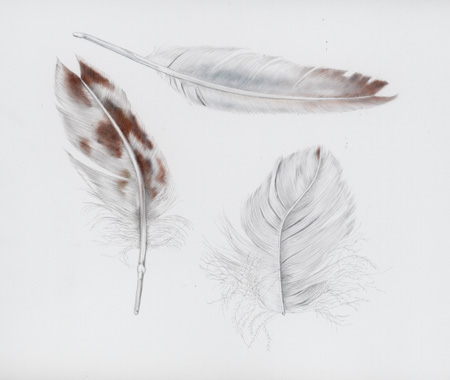
I just finished a Silverpoint and Pastel Dust class at NY Botanical Garden (NYBG). It was a great class both regarding what was covered in the class also the people were terrific. One of the best things about the class for me was trying a lot of different papers and surfaces.

Silverpoint drawings of feathers

Silverpoint drawings of feathers with pastel dust used to color the drawings.

Our instructor, Kathy Miranda, introduced us to a number of delicious papers for silverpoint drawing. I absolutely love TerraSkin paper, Plike paper, gesso and casein. TerraSkin is a paper made from rocks (sand, really, I’m guessing) and an eco friendly resin. This paper is recyclable. It will break down and revert to stone dust when exposed to weather for a few months. It’s a great surface to draw on and it comes in different weights. Plike has a velvety finish and takes the pastel dust very well. The thing to be most mindful of is how fragile the surface is. You can do a bit of erasing on this paper actually its more like a bit of lifting. It won’t erase completely. I did some nice drawings in the class, egg shells, another seashell, acorns and my very favorite of the series, feathers.

Alice

My First Post

This is my first post so I’ll just be original and tell you what you would read on my “about” page here at bountifulpixels.com…

I was born in the Bronx, New York and my family moved to the small town of Pelham, New York (its the smallest town in NY state) when I was five. Growing up so close to Manhattan and it was a regular thing to have class trips to the museums in New York City. In addition, my brother, Tom, went to art school which exposed me to possibility of creating art. I followed right behind him, including going to the same art school as he went to—the School of Visual Arts.

I discovered botanical illustration in 2006 and have been taking classes at the New York Botanical Garden since then. Not only do I love the beauty of the plants and flowers. I love the science behind them. How the plant grows, the leaf structure, the benefits to the environment it lives in, the animals who benefit from it and how it reproduces.